Showing posts with label crafty corner. Show all posts

Friday, February 24, 2012

CRAFTY CORNER


AS CUTE AS A BUTTON

By Sewsouk

Button

a small fastener securing two pieces of cloth. The button goes either through a cloth or thread loop or through a button hole in the fabric

Usually now made of plastic but also of metal, shell, fabric, yarn, wood and pottery.

There are three main types of attachment

shank- an attachment to the button which has a hole through which the thread is passed so it can be sewn onto the garment or object

sew through 2 or 4 holes in the button.

stud buttons which are usually metal pressed through the fabric and used particularly on jeans and denim jackets

Buttons can be a work of art and can be highly decorative.

Historically early buttons were used as ornaments or seals rather than as fasteners. Earliest examples are about 5000 years old and made of shell . Buttons from 2600BC have been found in China and ancient Rome.

Artisans make buttons and also they are factory manufactured.

N
owadays there are many forms of buttons:-

metal, embroidered, passementarie, lacquered,enamelled,woven, painted, ceramic, jewelry making, printed, fabric covered, knotted and crocheted.

Buttons are usually used on clothing but also on bags and containers.

Artisans not only make buttons they use them in interesting ways.

HHU Team Button Lovers

HHU team love using and making buttons in so many interesting and different ways. Here are just a few


FabricGreetings.


Fabric uses buttons to add colour, 3 dimensions, texture . She uses buttons in interesting shapes on her beautiful fabric greetings cards and ACEOS. She even incorporates them into the subject of the picture to wonderful effect.


Jeanie Bean Handknits uses buttons on her hats, cowls,phone and ipad cases. I love the way she chooses the shapes, colours, patterns and materials of her buttons to offset the texture and colours of her chunky knits to perfection.


Sewsouk that's me!

I make knotted and crochet fibre buttons to traditional Moroccan designs and also soutache buttons. These can be used in textile jewelry but a few look wonderful on plain fabric as an unusual fastener. I use mother of pearl and shell buttons in textile jewelry to add texture and subtle sparkle.


Womanwithtools incorporates beautiful vintage buttons into her jewelry pieces- She cleverly manages to make her pieces so they don't look like a button appendage but an integral part of the jewelryLink


Nouveaux Retro . She is so knowledgeable about vintage buttons. She is a collector and sells amazing collections of vintage buttons in her vintage shop. Crafty corner are hoping she will write a feature for us soon about vintage buttons.


NancyEllenStudios uses interesting buttons on many of her fabric designs. I love the way she uses buttons on these cushion covers


Headchange makes beautiful wooden buttons. I love the grains on her larger buttons. These have so many uses and are a wonderful must have supply.


KarinSF. Karin uses buttons to perfection in such a subtle way highlighting the quality pieces she makes. I love her fabric covered buttons on this top ... and the buttons on this cowl.

Monday, February 13, 2012

CRAFTY CORNER- Crafty Facts and Quilting Survey

Crafty Facts

Did you know?………………………..


By Sewsouk


Most of us know knitting is making fabric from a strand of yarn and usually uses 2 needles. The word knitting derives from the word “knots” and to knit means to tie or join.The earliest fabric pieces which have the appearance of knitting still existing are socks and stockings made in the 300 AD in Egypt.


Crochet
derives from the French wood “crochet "
meaning hook. There is no clear evidence to show that people did crochet work before the 1800s so it is a much more modern craft than knitting. The first crochet patterns were published in Europe in 1824. With the industrial revolution machine spun cotton became readily available replacing more expensive linen and so crochet became more popular. Early crochet hooks were nothing more than bent needles stuck into cork, richer ladies used decorated silver, steel, ivory and bone hooks though these were more to set off a rich lady’s fine hands rather than for serious work.


Quilting Survey


By FabricGreetings


Here are a few facts that came from a survey that is presented By “Quilters Newsletter” in cooperation with the International Quilt Market and Festival, a division of Quilts, Inc.

http://www.quilts.com/announcements/y2010/QIA2010_OneSheet.pdf

These results are from a survey conducted for 2010.

  • 14% of US households are home to one active quilter

  • total quilters in US exceeds 21 million

  • In 2010 – quilting households spent an average of $219 up 27% from 2006

Estimated total dollar value of quilting industry - $3.58 billion

Dedicated quilters are defined as households that spend more than $600 per year on quilting related purchases

Who is the dedicated quilter? (My profile)

  • Female (dedicated)

  • 62 years old ( over dedicated)

  • 72% attended college (dedicated)

  • Affluent - $91,602 HH income (very under dedicated)

  • Spend an average $2,442 per year on quilting (under dedicated)

  • Quilting for average of 16 years (over dedicated)

  • 44% prefer traditional quilts

  • 50% enjoy both traditional and contemporary styles (my choice)

  • Check out this web site for free quilting patterns:

http://www.freequiltpatterns.info


Etsy shops featuring quilting items:

www.NancyEllenStudios.etsy.com

www.EggMoneyQuilts.etsy.com

Sunday, February 5, 2012

CRAFTY CORNER


WHAT ARE ACEO's AND ATC's?

By FabricGreetings


ACEO's stands for Art Cards Editions and Originals. They are also known as ATC's – Artist Trading Cards.

I first heard of artist trading cards in an article in “Quilting Arts” magazine in 2004. Pokey Bolton, who was the editor, had challenged readers to send in a ATC. In return, she would send everyone who participated a card she had made. I sent her a card and received one in return that September. Then in October when I was attending the International Quilt Market in Houston, Texas, I was thrilled to see my card displayed along with all the others she had received on a wall of her booth at the show. Since then, I have been making them. The challenge is to get your design into such a small space.

These little work of art are a specific size -2.5” x 3.5” or 64mm x89mm. They are the same size as sports trading cards. And they are traded by artists and collectors all over the world. Many groups are organized and plan weekly trades.

http://www.flickr.com/groups/artisttradingcards/

http://groups.yahoo.com/group/artisttradingcards/

ACEO's are often designed using watercolors, pen and ink, screen printed, mixed media or fabric.

There is a team of ACEO artists on Etsy.

http://www.etsy.com/teams/6297/acetsy-aceo-etsy-street-team

Two of our HHU Members also sell ACEO's. Both sellers use very different techniques.

http://www.etsy.com/shop/anikasart

http://www.FabricGreetings.etsy.com


A CRAFTY DESTINATION


By FabricGreetings

There are some places you hear about and just want to see – The Statue of Liberty,
The Grand Canyon, Mount Rushmore... the list can go on forever. Many years ago
I
was attending a sewing event and heard someone mention a fabric store in
North Carolina.
I immediately filed it away in my memory bank. Since my sister
moved to Georgia and we
drive to see her, I get to visit this “find”.
And a find it is.

Mary Jo's Cloth Store is located in Gastonia, NC. Right off of I-85.

Over the years, we have made Gastonia our overnight stop on our trip south.
It has been
said that if they do not have it, you do not want it. Located in this
32,000 sq foot store
is everything a sewist could want....fabric, trims,
buttons, notions, and on and on.
They are most helpful when you call and offer a mail order service that is
fantastic.
They now have a web site and a blog.


So I encourage you to read about this little bit of heaven in the following article.
I am heading there in a couple of weeks and am already making my list.


m
http://www.charlotteobserver.com/2008/08/23/148179/landmark-store-
is-the-fabric-of.htl


http://www.threadsmagazine.com/item/6948/a-special-trip-to-mary-jos-cloth-store


http://maryjos.com/

http://maryjoscloth-design.blogspot.com/

Sunday, January 29, 2012

Crafty Corner- Embroidery tells a Story

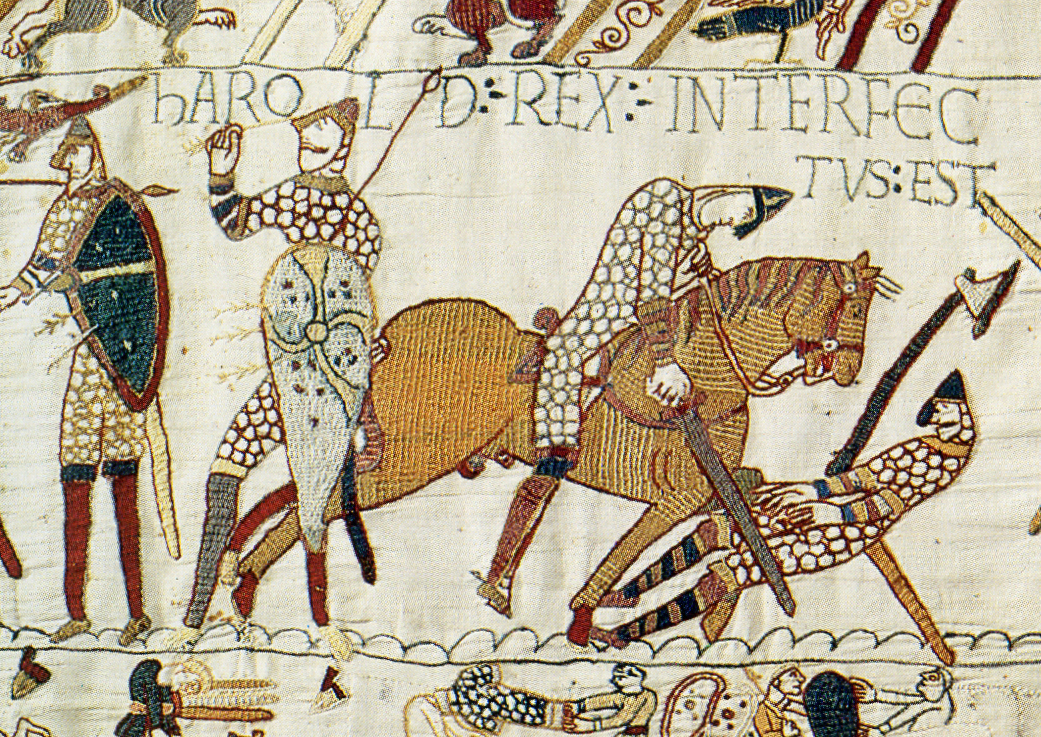
Bayeux Tapestry- King Harold is dead!


CRAFTY CORNER


Embroidery tells a story

By sewsouk

There is much more to embroideries than may be seen at first glance. You have to look carefully to see the story they tell.

The first embroideries I saw were enormous French ones which filled almost the whole wall- you had to stand so far away to see what the pictures were that you lost the sense that they were made up of thousands of tiny stitches- they left me cold which is sad as they must have taken years of work by many, many gifted embroiderers.

Then my parents took me to Bayeux to see the embroidery of the Norman invasion of England - “The Bayeux Tapestry” and my love of embroidery began. Made from wool on linen and over 70 feet long its pictures wind round the room and show the journey from France, the fighting and even the arrow shot into King Harold’s eye . Although made a little later than the famous battle of 1066, in the 1070s, it nevertheless gives a fairly accurate portrayal of early medieval life- the soldiers’ uniforms stitched in minute detail- almost like a photo recording life at the time and what happened- a story full of interest to an historian as well as fibre artists.

Embroidery does not necessarily just tell its story through its pictures but can also do so from its colour, design , the type of yarn used and the style and types of stitches. It may tell of who made it, where they made it and who it was made for. For instance here in Morocco where I now am the embroidery from Fez is most often vibrant blue or black on white cotton fabric and is made up of tiny geometric shapes.

The style of Meknes is similar in the shapes and stitches but is usually in a number of bright colours


Embroidery from Meknes


Embroidery from Fez


and from Rabat embroidery is full of colourful flowers in satin stitch. Much embroidery shows off the skill of the craftswomen who made it. Families stitch the love and pride they have in their skills into the designs which were often traditionally made as a “wedding chest” for a much loved daughter or grand daughter and to show a bridegroom’s family of the quality skill and love of the bride’s family.

Embroideries can have hidden messages. Women stitched the names of their sweethearts or things they liked or were of interest to them into their work. Mary Queen of Scots famously stitched messages into her embroideries made during her years of captivity by Elizabeth 1 about politics, her favourites and rivals. World War 11 prisoners of war stitched hidden Morse code messages in embroideries supporting the King and insulting Hitler. These were so well hidden that the Germans even exhibited them in the prisoner of war camps!

With today’ s modern yarns it is possible to stitch secret messages into embroidery which are only revealed after dark when the messages glow in the dark

Embroidery is ever changing with new designs, stitches created and new subjects. Technology is also embraced in modern embroidery to tell a story. Here is a sequence of embroidered texts from separate conversations about love

http://www.textually.org/textually/archives/2008/11/021857.htm

Next time you look at an embroidery take a closer look to see the story or message behind the stitches.